Free Sketch-Style CO₂ Reduction Icons: Vector & Raster Downloads for Eco-Conscious Design
Why Visual Clarity Matters in Climate Communication
In today’s fast-paced digital world, complex ideas like CO₂ reduction need simple, memorable visuals to resonate. A well-designed icon doesn’t just decorate a page—it communicates urgency, action, and responsibility at a glance. That’s where sketch-style CO₂ reduction icons shine: they blend artistic authenticity with environmental purpose. Unlike sterile, overly technical graphics, sketch icons feel human, approachable, and grounded—perfect for sustainability reports, climate education tools, green apps, or eco-branding projects.
What Makes These Icons Truly Versatile?
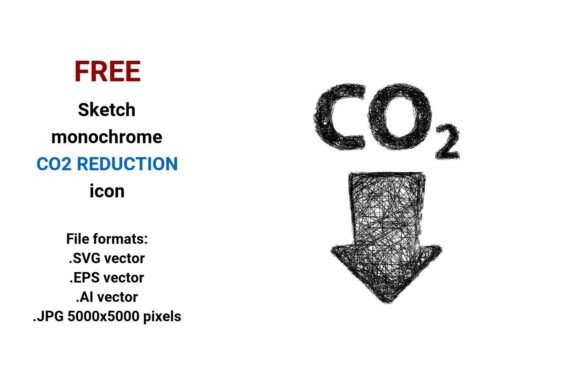
We offer a FREE Sketch CO₂ Reduction Icon set—including a matching FREE sketch black and white CO₂ reduction icon—in four essential file formats:
- .SVG vector — Ideal for websites, responsive UIs, and modern web frameworks (works flawlessly in HTML/CSS/React/Vue)
- .EPS vector — Industry-standard for print layouts, large-format banners, and professional design software like Adobe InDesign
- .AI vector — Fully editable in Adobe Illustrator, allowing designers to tweak colors, strokes, or composition without quality loss
- .JPG (5000×5000 pixels) — High-resolution raster version perfect for presentations, social media posts, posters, or when vector support isn’t available
This multi-format flexibility ensures your emission reduction visuals work everywhere—from a mobile app interface to a classroom handout or a city-wide sustainability campaign.
Understanding Vector vs. Raster: Why Format Choice Matters
A vector image is built from mathematical equations—not pixels. It defines points, lines, curves, and shapes using coordinates and formulas. This means it scales infinitely: shrink it to fit a tiny app button or enlarge it to cover an entire building wall—and it stays razor-sharp. In contrast, raster images (like JPGs) are grids of fixed pixels; zoom too far, and they blur or pixelate.
That’s why our CO₂ reduction icons include both vector (.SVG, .EPS, .AI) and high-res raster (.JPG) options. Need crisp, scalable assets for a web dashboard? Use the SVG. Preparing a printed annual sustainability report? The EPS or AI gives full editing control. Sharing on Instagram or embedding in a PowerPoint? The 5000×5000 JPG delivers stunning clarity without technical overhead.
How These Icons Support Real-World Climate Action
Icons are more than decoration—they’re functional tools in the fight against climate change. Consider these everyday uses:
- Educational Resources: Teachers use sketch CO₂ reduction icons in lesson plans to illustrate carbon footprints, renewable energy transitions, or lifestyle changes—making abstract data tangible for students.
- Corporate Sustainability Portals: Companies embed CO₂ reduction buttons in internal dashboards to let employees log carpool trips, track paperless initiatives, or pledge energy-saving actions.
- Mobile Apps & Web Tools: Climate calculators, carbon offset platforms, or green shopping apps rely on intuitive, hand-drawn icons to guide users through emission-reduction workflows—reducing cognitive load and increasing engagement.
- Community Campaigns: Local governments and NGOs use sketchy icon sets in flyers, murals, and workshops—because hand-sketched art signals authenticity and community involvement, not corporate detachment.
Debunking Common Misconceptions
Some assume “sketch-style” means “unprofessional.” Not true. In fact, research in UX and behavioral science shows that hand-drawn or line-art elements increase perceived trustworthiness and approachability—especially around emotionally charged topics like climate anxiety. A clean, minimal artistic sketch icon conveys care and intentionality, not amateurism.
Others believe vector icons must be colorful or complex. Our sketch black and white CO₂ reduction icon proves otherwise: monochrome line art emphasizes form, function, and flexibility. You can recolor it effortlessly in any design tool—or leave it neutral to match minimalist branding guidelines.
Design Philosophy Behind the Sketch Aesthetic
This collection embraces sketch design principles intentionally:
- Freehand rhythm: Slight line variations mimic natural drawing—adding warmth and humanity to technical subject matter.
- Minimal mark-making: Each curve and stroke serves a purpose—no visual noise, only essential symbolism (e.g., a rising leaf breaking through a downward arrow to signify emission reduction).
- UI-ready proportions: Balanced negative space and consistent stroke weight ensure readability at small sizes—ideal for CO₂ reduction buttons or navigation elements.
- Cross-platform harmony: Whether used as a pictogram in a government infographic or a graphic element in a startup’s pitch deck, the style remains cohesive and recognizable.
Practical Tips for Using Your Free Icons
Maximize impact with these best practices:
- Pair with clear microcopy: An icon alone rarely explains “what to do.” Always accompany your CO₂ reduction icon with brief, actionable text—e.g., “Reduce emissions by switching to LED lighting.”
- Use consistent stroke weight across interfaces: If you’re building a toolkit or app, apply the same 1.5pt line thickness across all line art icons for visual unity.
- Leverage SVG interactivity: With the .SVG file, add hover effects, animations, or click-triggered tooltips—transforming a static emission reduction button into an engaging learning moment.
- Respect accessibility: When using the JPG or embedding SVGs, always include descriptive
alttext like “Sketch-style icon showing a downward arrow overlaid on a CO₂ molecule—symbolizing carbon dioxide reduction.”
Why “Free” Doesn’t Mean “Limited”
These freehand sketch icon resources are offered without watermarks, attribution requirements, or usage restrictions—because climate communication should be barrier-free. Whether you’re a student designing a school project, a nonprofit launching a public awareness drive, or a developer building an open-source carbon tracker, you can use these icons confidently in commercial and non-commercial contexts alike.
They’re part of a broader movement toward open environmental design assets—recognizing that solving global challenges demands shared, reusable, and ethically sourced creative tools.
Final Thought: Icons as Quiet Catalysts
A CO₂ reduction icon may seem small—but its ripple effect is real. It appears on a teacher’s slide, sparking a student’s first climate project. It lives in a city’s transit app, nudging commuters toward greener choices. It anchors a startup’s mission statement, shaping product decisions from day one. By choosing thoughtful, scalable, and human-centered visuals—like our sketch CO₂ reduction icon suite—you’re not just selecting artwork. You’re reinforcing a mindset: that clarity, creativity, and collective action go hand-in-hand in building a lower-carbon future.
Download your free set today—and turn intention into interface, one authentic line at a time.