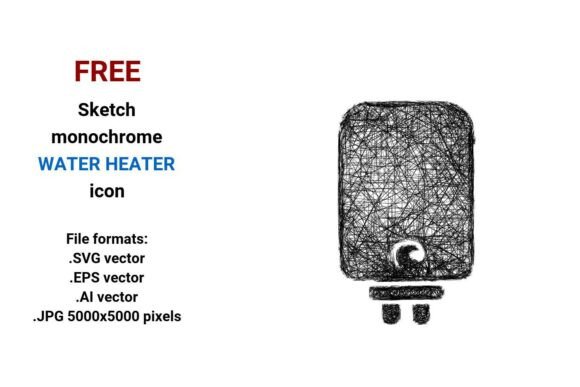
FREE Sketch Water Heater Icon: A Versatile Vector Toolkit for Designers and Developers
When designing interfaces, dashboards, presentations, or educational materials involving plumbing systems, energy infrastructure, or home automation, visual clarity matters. A well-crafted icon communicates function at a glance—especially in technical or user-facing contexts where precision and familiarity coexist. The FREE Sketch Water Heater Icon stands out not just for its aesthetic appeal but for its functional flexibility across disciplines. Unlike raster-based illustrations that blur when scaled, this collection leverages vector mathematics to preserve crispness at any dimension—making it ideal for everything from mobile app buttons to large-format architectural signage.
Why Vector Format Matters for Technical Icons
A vector image is built from mathematical definitions—not pixels. Points, paths, curves, and fills are stored as scalable instructions rather than fixed grids. This means the same sketch black and white water heater icon can appear razor-sharp on a 16-pixel toolbar button or fill a 48-inch trade show banner without distortion or aliasing. For professionals working with HVAC schematics, smart home dashboards, or maintenance manuals, scalability isn’t a luxury—it’s foundational.
Consider a facility manager updating a building-wide monitoring interface: they need consistent iconography across devices. A single .SVG vector file renders natively in modern browsers, supports CSS styling (color shifts, hover states), and integrates seamlessly into React, Vue, or Figma workflows. Meanwhile, the included .EPS vector and .AI vector files allow deep editing in Adobe Illustrator or CorelDRAW—adjusting stroke weight, isolating layers, or recoloring individual components like the heating element or thermostat dial. Even the high-resolution .JPG 5000x5000 pixels variant serves niche needs: print-ready documentation, slide decks requiring pixel-perfect embedding, or legacy CMS platforms that don’t support SVG uploads.
Diverse Applications Across User Groups
The utility of the FREE Sketch Water Heater Icon extends far beyond generic “water” symbolism. Its hand-drawn aesthetic bridges technical accuracy and approachability—a rare balance in industrial iconography.
- Designers & UI/UX Professionals: Use the sketched outline style to reinforce a cohesive “toolkit” visual language—pairing it with other hand-drawn icons for settings panels, device status indicators, or onboarding flows. Its isolated composition ensures clean layering over gradients or textured backgrounds.
- Engineers & Technicians: Embed the boiler icon into schematic overlays, maintenance checklists, or AR-assisted repair guides. The sketch’s clear depiction of inlet/outlet pipes, tank shape, and control dial supports rapid visual parsing during time-sensitive diagnostics.
- Educators & Curriculum Developers: Leverage the artistic, freehand quality to demystify thermodynamics concepts. A water heater drawing in lecture slides helps learners distinguish between storage tanks, heat exchangers, and circulation loops—without overwhelming detail.
- Business Owners & Marketers: Apply the icon across service websites, service call booking widgets, or seasonal promotion banners (“Winter-Ready Hot Water Heater Service”). Its neutral black-and-white palette adapts effortlessly to brand color schemes via simple CSS filters or vector recoloring.
- Hobbyists & Makers: Integrate the editable vector into DIY smart-home dashboards (e.g., Home Assistant Lovelace UI), custom PCB silkscreens, or 3D-printed control panel labels—all while retaining legibility at micro-scales.
Design Philosophy: Function Meets Expressive Clarity
This isn’t merely a stylized water heater—it’s a communicative artifact. The sketch illustration deliberately avoids photorealism to prioritize recognition speed and cross-cultural readability. No brand logos, no proprietary controls, no ambiguous shadows: just an essentialized, handdrawn water heater icon that signals “hot water generation” instantly. The stroke-based construction emphasizes structure—visible pipe connections, a distinct cylindrical tank, and subtle textural hints suggesting metal casing or insulation.
That intentional minimalism serves practical ends. In dashboard interfaces where cognitive load must stay low, users scanning dozens of device statuses benefit from consistent visual grammar. A water heater button using this icon doesn’t compete with adjacent icons for HVAC zones, lighting circuits, or security sensors—it harmonizes. Likewise, in multilingual environments, the absence of text makes it truly universal: no translation needed for “boiler,” “heater,” or “hot water heater.”
Technical Considerations When Implementing
While the FREE Sketch Water Heater Icon offers broad compatibility, thoughtful implementation ensures optimal performance and accessibility:
- SVG Optimization: Before deploying the .SVG file in production, run it through a tool like SVGO to strip metadata and redundant points. This reduces file size without affecting appearance—critical for fast-loading web apps.
- Color Accessibility: Though delivered in black-and-white, the icon’s stroke-based design allows easy contrast adjustment. When used as a hot water heater button, ensure foreground/background contrast meets WCAG 2.1 AA standards (4.5:1 minimum) for users with low vision.
- Responsive Scaling: Avoid fixed pixel dimensions in CSS. Instead, use relative units (e.g.,
width: 1.5em;) so the icon scales proportionally with surrounding text—maintaining visual hierarchy across device sizes. - Legacy Support: For older platforms lacking SVG support, the high-res .JPG serves as a fallback. But avoid using JPG for interactive elements—lack of transparency and scalability limits interactivity and responsiveness.
- Editing Workflow: Prefer .AI or .EPS for structural edits (e.g., separating tank from pipes for animation). Reserve .SVG for web delivery and .JPG only for static, non-interactive contexts like printed handouts.
Real-World Integration Examples
In practice, the versatility of this resource reveals itself through context:
A bathroom renovation app uses the sketch icon as a tap-target in a “Plumbing Layout Planner”—users drag-and-drop the water heater into virtual floor plans. Because the vector retains sharp edges at all zoom levels, contractors reviewing blueprints on tablets see identical fidelity whether viewing the entire bathroom or zooming into valve connections.
An energy education nonprofit incorporates the icon into an animated explainer video about residential hot water efficiency. Animators import the .AI file, separate the heating element path, and apply a pulsing glow effect to visualize thermal activation—something impossible with a flattened JPG.
A smart home startup builds its mobile dashboard around a unified “device family” icon set. The FREE Sketch Water Heater Icon sits alongside similarly styled icons for thermostats, pumps, and radiators. Users instantly recognize category relationships—even before reading labels—reducing onboarding friction.
Comparing Use Cases: When to Choose Which Format
Selecting the right file format depends less on preference and more on workflow stage and output medium:
- .SVG vector: Best for live web interfaces, dynamic dashboards, and responsive applications. Supports interactivity, theming, and lightweight delivery.
- .AI vector: Ideal for designers needing full layer control—adding custom annotations, integrating with brand guidelines, or preparing assets for print production with bleed and trim marks.
- .EPS vector: Preferred for legacy print workflows, especially when collaborating with third-party printers who require PostScript compatibility.
- .JPG 5000x5000 pixels: Reserved for situations demanding absolute pixel fidelity—such as high-DPI presentation exports, archival PDFs, or platforms blocking SVG uploads.
Notably, all four formats depict the same core water heater icon—ensuring visual continuity regardless of where or how it’s deployed. That consistency reinforces brand trust and reduces user learning curves across touchpoints.
Broader Implications for Technical Visual Communication
Icons like this reflect a growing shift in how technical domains approach visual language. Gone are the days when engineering diagrams relied solely on ISO-standard symbols understood only by specialists. Today’s effective communication blends regulatory clarity with human-centered design—making systems understandable to homeowners, technicians, and developers alike.
The FREE Sketch Water Heater Icon exemplifies this evolution: it satisfies ISO 8178-3’s functional representation requirements for heating equipment while retaining expressive warmth through its sketch aesthetic. It functions as both a boiler icon in a utility control room and a friendly hot water heater button in a consumer-facing app—without compromising integrity.
For educators teaching sustainable infrastructure, researchers mapping energy distribution networks, or city planners visualizing district heating systems, such adaptable assets lower barriers to entry. They turn abstract concepts—thermal transfer, flow dynamics, system interdependence—into tangible, scannable visuals. And because it’s freely available, it democratizes access to professional-grade resources without licensing friction or budget constraints.
Final Thoughts on Long-Term Utility
Unlike trend-driven graphics that date quickly, this icon’s enduring value lies in its foundational design choices: monochrome neutrality, vector fidelity, and semantic clarity. As interface patterns evolve—from voice-controlled dashboards to spatial computing environments—the underlying need for unambiguous, scalable, and editable representations remains constant.
Whether you’re sketching a wireframe, annotating a schematic, building a training module, or prototyping a smart-device interface, the FREE Sketch Water Heater Icon delivers more than decoration. It delivers precision, adaptability, and quiet authority—proving that even the most utilitarian objects, rendered thoughtfully, become powerful tools for understanding our built world.