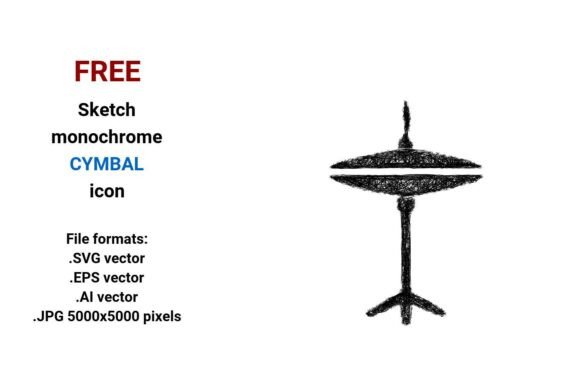
FREE Sketch Cymbal Icon: Minimal, Scalable, and Ready for Real Creative Work
Whether you’re designing a music education app, building a percussion-focused blog theme, or prototyping a studio gear marketplace, visual clarity matters — especially when representing instruments as expressive and dynamic as cymbals. The FREE Sketch Cymbal Icon delivers exactly that: a clean, hand-drawn aesthetic grounded in function. It’s not just another decorative element — it’s a purpose-built, monochrome icon rooted in real-world design needs. And because it comes in four production-ready formats — .SVG vector, .EPS vector, .AI vector, and a high-resolution .JPG (5000×5000 pixels) — it bridges the gap between sketch-like authenticity and professional scalability.
Why a Sketch-Style Cymbal Icon Fits Today’s Design Reality
Design trends have shifted decisively away from over-polished, skeuomorphic interfaces toward intentional minimalism — but not at the expense of personality. Users respond to icons that feel human-made: slightly uneven strokes, subtle curvature, visible pencil texture. That’s where the FREE sketch black and white cymbal icon stands out. It’s not a photorealistic crash cymbal rendering; it’s a line sketch icon that communicates “percussion” through gesture and economy. This aligns with how modern UI designers approach iconography: prioritizing recognition over realism, and usability over ornamentation.
Consider a mobile app for drummers learning rudiments. A flat, geometric cymbal icon might read as generic. But a hand drawn sketch cymbal icon, with its slight taper on the edge and organic curve, subtly signals movement, resonance, and acoustic character — all without needing color or shading. That’s functional symbolism. And because it’s delivered in vector formats, it scales flawlessly across devices — from a tiny toolbar button on a smartwatch to a full-screen hero graphic in a music lesson video.
Vector Flexibility Meets Practical Workflow Needs
A vector image is more than just “scalable.” It’s mathematically defined — built from points, lines, and curves — meaning it retains crispness at any size and remains fully editable in professional tools. When you download the FREE Sketch Cymbal Icon, you’re not getting a flattened PNG you can’t adjust. You’re getting native files for real work:
- .SVG: Ideal for web use — embed directly into HTML, style with CSS, animate with JavaScript, and ensure accessibility via
aria-labelsupport. - .EPS: Compatible with legacy print workflows and widely supported by illustration and layout software.
- .AI: Fully layered and editable in Adobe Illustrator — perfect for tweaking stroke weight, adjusting hatch density, or integrating into larger brand assets.
- .JPG (5000×5000): High-res raster fallback for platforms that don’t support vectors — social media banners, presentation decks, or printed handouts — without pixelation or blur.
This multi-format approach reflects how professionals actually work today: fluidly moving between digital and print, web and native apps, rapid prototyping and final delivery. You no longer need to choose between “sketchy charm” and “production readiness.” With this set, you get both — out of the box.
From Crash Cymbal to UX Asset: How Musicians and Designers Use It Differently
The term crash cymbal isn’t just musical jargon here — it’s a functional cue. In interface design, a crash cymbal icon often represents an action: a notification trigger, a recording start point, or a dramatic transition. Its cultural association with impact and emphasis makes it ideal for buttons labeled “Play,” “Alert,” or “Highlight.” That’s why the sketch cymbal button variant — with its bold outline and balanced negative space — works so well in dashboards or music production software.
Meanwhile, educators use the same freehand cymbal icon to label sections in online courses (“Percussion Fundamentals”), while podcasters drop it into episode thumbnails for rhythm-focused interviews. Freelance designers integrate it into branding kits for indie record labels — pairing the doodle style icon with serif typography to evoke analog warmth in a digital context. Even hardware startups sketching prototypes for new electronic drum pads rely on these icons during early-stage user testing: the rough, sketchy line icon feels less prescriptive, encouraging honest feedback about layout and hierarchy.
Monochrome Design Is No Longer a Limitation — It’s a Strategy
Black-and-white doesn’t mean basic. In fact, monochrome icons like this FREE sketch black and white cymbal icon offer distinct advantages: faster load times, stronger contrast for accessibility, and seamless integration into dark-mode interfaces. They also sidestep color psychology pitfalls — no risk of misreading a red cymbal as “error” or blue as “cold.” Instead, meaning comes from form: the circular shape implies resonance, the curved edge suggests vibration, and the single continuous stroke echoes the motion of a stick strike.
This is especially valuable for global projects. A simple line sketch avoids cultural assumptions tied to color or realism. Whether viewed in Tokyo, Berlin, or São Paulo, a pencil sketch icon reads instantly as “cymbal” — not because of local conventions, but because of shared visual grammar: circle + curve + implied motion = percussion.
Real Editing, Real Control — Not Just “Free” in Name Only
“Free” shouldn’t mean “locked down.” Many free icon sets deliver flattened images or restrictive licenses. This FREE Sketch Cymbal Icon is different: it’s truly editable. Open the .AI file and adjust anchor points to exaggerate the bell or soften the taper. Import the .SVG into Figma and recolor it dynamically using CSS variables. Use the .EPS version to add foil stamping effects for premium packaging. Even the .JPG retains enough resolution to hold detail in large-format prints — think vinyl sleeve inserts or studio wall posters.
That level of control supports evolving creative practices. A musician launching a Patreon might start with the JPG for email headers, then switch to SVG for their website’s interactive timeline. A product designer iterating on a metronome app could test three versions — subtle hatch texture, bolder stroke, simplified outline — all from the same source file. No re-drawing. No licensing friction. Just flexibility baked into the asset itself.
Beyond Decoration: Why This Fits Broader Creative Shifts
We’re seeing a quiet but steady return to tactile sensibility in digital spaces — not as nostalgia, but as intention. Tools like Figma now include sketch-mode plugins; designers use Procreate for wireframing; even enterprise SaaS dashboards experiment with sketch style icons to reduce cognitive load. The FREE Sketch Cymbal Icon fits naturally within that shift: it’s human-scale, legible at a glance, and technically robust.
It also responds to how people consume music today — not just as listeners, but as participants. With home recording booming and AI-assisted composition rising, visual language around instruments must be both precise and inviting. A curved, minimal sketch icon does both: it signals technical accuracy (via correct cymbal proportions) while lowering barriers to engagement (through approachable line work).
In short, this isn’t just a cymbal icon. It’s a small but meaningful piece of infrastructure — for educators explaining sound physics, for developers building audio APIs, for marketers promoting live sessions, and for anyone who believes that good design should serve the music, not compete with it.