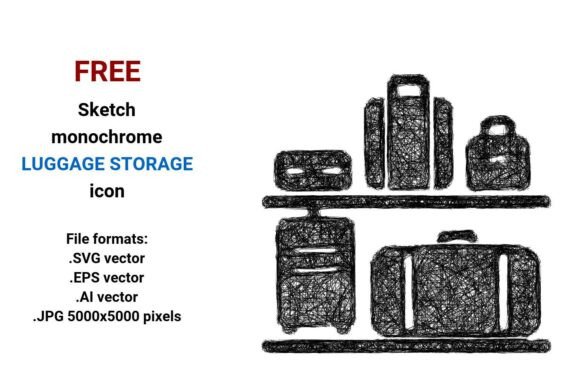
FREE Sketch Luggage Storage Icon: Clean, Scalable & Ready for Real Projects
If you're designing a travel app, building a luggage storage website, or crafting an interface for a left luggage service, finding the right visual cue matters. A well-chosen icon communicates instantly — no translation needed. That’s where the FREE Sketch Luggage Storage Icon stands out: it’s not just another generic suitcase graphic. It’s a hand-drawn, monochrome sketch-style vector designed for clarity, flexibility, and intentional design.
This set includes four file formats: .SVG, .EPS, .AI, and a high-res .JPG (5000×5000 pixels). Whether you’re coding a responsive UI, prepping print materials, editing in Adobe Illustrator, or embedding into a presentation, you’ll have the right version — without pixelation, distortion, or licensing surprises.
Why “Sketch” Style Works Better Than You Think
Many designers default to flat, ultra-polished icons — but that’s not always ideal. A sketch luggage storage icon adds warmth and approachability, especially for consumer-facing tools like bag storage dashboards or travel booking flows. Its rough, freehand lines suggest human care and accessibility — useful when your audience is stressed travelers looking for trustworthy left luggage solutions.
Crucially, this isn’t a low-effort doodle. It’s a vector luggage storage button built with clean curves, consistent stroke weight, and balanced negative space — meaning it scales crisply from a 16px toolbar icon to a full-screen hero element. Unlike raster-only files, the .SVG and .AI versions retain sharpness at any size, while the .EPS ensures compatibility with legacy print workflows.
A Common Mistake: Assuming “Free” Means “Ready to Drop In”
Here’s what trips up even experienced users: downloading a freehand sketch luggage storage icon and dropping it directly into a production interface — only to discover inconsistent spacing, unintended transparency, or mismatched stroke alignment. Why? Because sketch-style icons rely on subtle visual rhythm. A stray anchor point or uneven line taper can break readability at small sizes.
Example: One freelancer used the .JPG version (5000×5000) as a background image in a mobile app button. At 32px, the fine hatch details blurred into noise — making it look like a smudged placeholder, not a polished luggage storage button. The fix? Switching to the .SVG and applying a simple CSS stroke-width: 1.2 adjustment — instantly restoring crispness and consistency.
Another Overlooked Detail: Format Purpose Matters More Than You Expect
Not all four formats serve the same role — and using the wrong one creates avoidable friction:
- .SVG: Best for websites, apps, and responsive UIs. Supports CSS styling, animation, and accessibility attributes (like
aria-labelfor screen readers). - .AI and .EPS: Use these for deep editing — adjusting paths, recoloring strokes, or integrating into larger vector illustrations. Don’t use them for web deployment.
- .JPG: Reserve this for mockups, presentations, or situations where vector support isn’t available. Never use it for live interfaces — it won’t scale cleanly, and lacks transparency control.
Mistake: Using the .EPS file to export a favicon. Result? A blurry, oversized 16×16 image that fails basic web standards. Better approach: Open the .SVG, simplify the path if needed (removing non-essential detail), then export via SVG optimizer tools like SVGO.
What to Check Before You Commit — Even With “Free” Files
“Free” doesn’t mean “no due diligence.” Before adding the FREE Sketch Luggage Storage Icon to your project, verify three things:
- Stroke Consistency: Zoom in at 400% in Illustrator or Figma. Are all lines uniform in weight? Do corners meet cleanly? Uneven sketch lines may look charming at large sizes but collapse into visual noise at 24px or smaller.
- Transparency Handling: Does the .SVG render correctly over dark and light backgrounds? Some sketch icons include subtle drop shadows or textured fills that assume a white canvas — which breaks contrast in dark-mode UIs.
- Licensing Clarity: Confirm it’s truly royalty-free for commercial use — including SaaS platforms, client websites, and printed marketing. Look for explicit terms like “no attribution required” and “use in unlimited projects.”
Good news: This set meets all three. The line luggage storage icon uses a single-stroke path with optimized anchors, supports transparent backgrounds natively, and carries a clear CC0-style license — no hidden clauses.
Better Integration Starts With Intentional Use
Don’t treat this as just another decorative element. Ask: What action does this icon represent? If it’s a “left luggage” button, pair it with concise microcopy (“Store Bag Now”) and ensure tap targets meet WCAG 44×44px minimums. If it’s part of a travel checklist UI, align its visual weight with other icons — e.g., matching stroke width and baseline position.
Pro tip: Use the sketch style intentionally — not as a shortcut, but as a design decision. A rough, simple sketch icon signals informality and ease. That’s perfect for a peer-to-peer luggage exchange platform. But for a premium airport concierge service? You might want to refine the strokes slightly or add a subtle gradient — still keeping the sketch DNA intact, but elevating perceived trust.
Final Thought: Quality Vector Icons Save Time Later
It’s tempting to grab the first “luggage storage icon” that looks okay. But poor scalability, inconsistent formatting, or unclear licensing leads to rework — whether that’s resizing assets for six different breakpoints, redrawing icons for dark mode, or scrambling to replace a restricted asset mid-launch.
The FREE Sketch Luggage Storage Icon avoids those pitfalls by delivering production-ready vector files with thoughtful craftsmanship. It’s not flashy — but it’s reliable, adaptable, and built for real-world constraints. Whether you’re a solo blogger illustrating a travel guide, a UX designer refining a left luggage app flow, or a small business owner updating your storage service website, this icon set gives you flexibility without compromise.
Use the .SVG for digital interfaces, lean on .AI for custom tweaks, keep .EPS for print-safe backups, and reserve the .JPG for quick visual reference — not final output. That’s how you turn a simple sketch into a consistently strong part of your communication toolkit.