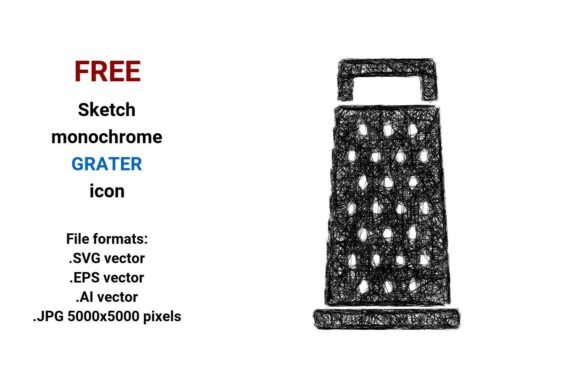
FREE Sketch Grater Icon
If you're designing a food blog, building an e-commerce site for kitchen tools, or crafting a clean UI for a cooking app, a well-chosen grater icon can quietly elevate clarity and visual cohesion. The FREE Sketch Grater Icon — offered in four versatile formats (.SVG, .EPS, .AI, and high-res .JPG) — stands out for its hand-drawn authenticity and technical flexibility. It’s not just another generic cheese grater icon; it’s a monochrome sketch icon that balances artistic expression with functional precision. Whether you’re a freelancer adding visual polish to a client’s dashboard or a small business owner updating your product page, this vector grater button delivers both personality and scalability.
Why “Sketch” Matters More Than You Think
Many designers assume any grater icon will do — especially if it’s labeled “free.” But the difference between a stiff, geometric icon and a freehand sketch icon is more than aesthetic: it signals tone. A crisp, flat icon might suit a tech SaaS interface; a soft outline sketch icon, with visible pencil strokes and subtle imperfections, works better for brands emphasizing craft, authenticity, or home cooking. That’s where the FREE Sketch Grater Icon shines — it’s a scalable, artistic symbol that reads as human-made, not algorithm-generated.
Yet here’s a common misstep: downloading the .JPG version first and assuming it’s sufficient. At 5000×5000 pixels, the JPG looks sharp on screen — but it’s still a raster image. Enlarge it for a large-format print menu or scale it down for a tiny mobile button, and you’ll hit pixelation or blurriness. Worse, you lose editability: no changing stroke weight, recoloring, or isolating parts of the grater shape. That’s why relying solely on the JPG undermines the core advantage of this set — its vector image foundation.
Vector Formats Aren’t Interchangeable — Know Which One to Use
A vector image is built from mathematical paths — points, lines, curves — so it scales infinitely without quality loss. But not all vector formats serve the same purpose:
- .SVG: Best for websites, dashboards, and UI kits. It loads fast, supports CSS styling (e.g., hover color changes), and works natively in modern browsers. Use this for your grater button in a recipe app or food-themed landing page.
- .AI: Ideal if you use Adobe Illustrator regularly. You can ungroup layers, adjust anchor points, or integrate the sketch grater into larger logo compositions or marketing collateral.
- .EPS: A legacy format, still useful for print workflows (like packaging or brochures) when working with older RIP software or service bureaus.
- .JPG: Reserve this only for quick mockups, social media previews, or situations where vector support isn’t available — never for final production assets.
Mistaking .EPS for universal compatibility is another frequent oversight. While .EPS files *can* be opened in many apps, they often render inconsistently across platforms — especially with complex strokes or transparency. For most digital use cases today, .SVG is safer and more future-proof.
Don’t Overlook the “Sketch” Nuances in Your Workflow
This FREE Sketch Grater Icon intentionally uses stroke-based drawing — thin, uneven lines that mimic pencil work. That’s great for expressiveness, but it means the icon relies on consistent stroke weight and spacing to remain legible at small sizes. If you shrink it to 16×16 pixels without adjusting stroke thickness or simplifying detail, the cheese grater becomes a muddy blob. Test it at actual usage sizes early: drop it into your UI toolkit at 24px, 32px, and 48px. Does the handle stay distinct? Is the grating surface still readable?
Also, avoid automatic “vector-to-raster” exports unless necessary. Some tools convert SVGs to PNGs behind the scenes — defeating the purpose of having a true vector grater button. Check export settings: look for “preserve vector data,” “SVG output,” or “no rasterization.”
What to Verify Before Downloading or Deploying
Before using the FREE Sketch Grater Icon, ask yourself three practical questions:
- Is the license truly free for my use case? Some “free” icons permit personal use only — not commercial projects, SaaS interfaces, or printed merchandise. Confirm whether attribution is required and whether redistribution (e.g., in a design system shared with clients) is allowed.
- Does the sketch style align with your broader visual language? If your brand uses bold, geometric icons everywhere else, dropping in a delicate pencil sketch grater may feel disjointed. Consider adapting stroke weight or pairing it with similarly textured elements — like a matching cheese icon or shred symbol — to maintain harmony.
- Are all file formats actually included and usable? Occasionally, download packages list .AI but deliver a flattened PDF instead. Open each file in its native app before committing time to integration. Try editing a path in Illustrator (.AI), viewing layers in InDesign (.EPS), and embedding in HTML (.SVG).
Better Choices Start With Intentional Use
Think of the FREE Sketch Grater Icon not as a decorative afterthought, but as a functional pictogram — part of your communication toolkit. Its scribble-inspired lines invite warmth; its monochrome palette ensures accessibility and versatility; its vector nature supports responsive design. When used thoughtfully, it helps users instantly recognize actions like “shred cheese,” “add ingredient,” or “customize recipe” — especially in food-related ecommerce or culinary education contexts.
So before you paste it into a layout, pause: Are you using the right format for the medium? Have you tested legibility at real-world sizes? Does it reflect the tone your audience expects? These aren’t nitpicky details — they’re what separate polished, professional results from forgettable clutter. The FREE Sketch Grater Icon gives you the raw material. Your attention to context, scale, and consistency turns it into something truly useful.