FREE Sketch Pomegranate Icon: A Scalable, Artistic Resource for Designers and Developers
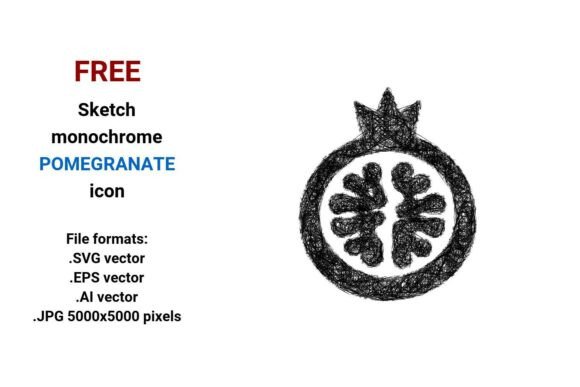
The FREE Sketch Pomegranate Icon is a hand-drawn, monochrome vector illustration of the granada fruit—a stylized yet recognizable representation of the pomegranate, rendered with intentional sketch-like imperfections. Unlike photorealistic or overly polished icons, this version embraces organic line work, subtle irregularities, and expressive curves—making it especially suited for projects that value authenticity, artistic tone, or human-centered interface design. It’s delivered in four widely compatible formats: .SVG, .EPS, .AI, and a high-resolution .JPG (5000×5000 pixels). This combination supports both digital scalability and print-ready fidelity.
What Makes This Sketch Pomegranate Icon Distinct?
At its core, the FREE Sketch Pomegranate Icon belongs to the broader category of line art and sketched icon resources—but stands out due to its deliberate balance between minimalism and expressiveness. It’s not just “simple” or “minimal”; it’s hand drawn, with visible pencil-like texture, gentle tapering strokes, and slight asymmetry that evokes a real sketch—not a digitally smoothed approximation. The design isolates the fruit cleanly against a transparent background, making it ideal for UI icon, dashboard, or branding use where clarity and visual cohesion matter.
As a vector image, it leverages mathematical paths rather than fixed pixels—meaning it scales infinitely without quality loss. Whether used as a tiny pomegranate button at 24×24 pixels in a mobile app or enlarged to poster size for an educational exhibit on fruit nutrition, the lines remain crisp and consistent. That’s a functional advantage over raster-only alternatives—even high-res JPGs degrade when stretched beyond their native dimensions.
How It Compares Across Formats and Use Cases
Each included format serves a specific workflow need:
- .SVG: Best for web interfaces, responsive dashboards, and modern front-end development. Integrates cleanly into HTML/CSS, supports CSS styling (e.g., stroke color changes), and loads quickly.
- .EPS and .AI: Preferred by professional designers using Adobe Illustrator or legacy print production tools. These retain full editability—layers, anchor points, and stroke attributes can be adjusted without quality compromise.
- .JPG (5000×5000): Serves as a fallback for platforms that don’t support vector imports—like certain CMS editors, presentation software, or social media tools. Its resolution ensures sharpness even in large-format prints, though it lacks scalability or editable vectors.
This multi-format approach gives users flexibility most single-format icons lack. For example, a UX designer building a health-tracking app might embed the .SVG directly into buttons and navigation elements, while a marketing team uses the .AI file to adapt the icon for a brochure or packaging label—adjusting line weight or adding a subtle gradient behind the fruit outline.
When This Icon Fits—and When It Might Not
The FREE Sketch Pomegranate Icon excels in contexts where tone and intentionality matter. If your project communicates themes like natural wellness, botanical education, artisanal food branding, or mindful living, the sketchy, pen-inspired aesthetic reinforces those values more effectively than a flat, geometric icon would. It works well alongside other artistic, hand drawn, or rough UI assets—creating visual harmony across a dashboard or app interface.
However, it’s less suitable for highly technical, data-dense, or strictly corporate environments where neutrality and precision are prioritized. In a financial analytics platform, for instance, a clean, monoline line pomegranate icon may feel inconsistent next to standardized system icons. Similarly, if your team requires strict WCAG-compliant contrast ratios at small sizes, the fine sketch lines may require manual adjustment—unlike bolder, purpose-built UI icons designed for accessibility from the start.
Also consider audience expectations. While “granada” is botanically accurate and used regionally (especially in Spanish-speaking contexts), global users searching for “pomegranate” or “fruit” may not immediately associate the term “granada” with the fruit unless context is provided. The icon itself is universally legible, but naming conventions in asset libraries or documentation should reflect common search terms to aid discoverability.
Strengths, Tradeoffs, and Practical Decision Factors
One of the strongest advantages is its dual nature as both scalable and expressive. Many scalable icons sacrifice character for consistency; many expressive icons sacrifice versatility for style. This resource bridges that gap—without requiring custom illustration time or licensing fees.
A key tradeoff lies in customization depth. Because it’s delivered as a finished sketch—not a parametric or component-based design—it doesn’t offer built-in variants (e.g., open vs. closed fruit, seeds shown vs. hidden). Users wanting to highlight the seeds inside the pomegranate, for example, would need to modify the vector manually. That’s straightforward in Illustrator but adds a step for non-designers.
Another consideration is integration effort. While .SVG is developer-friendly, teams using older frameworks or strict content security policies may need to sanitize inline SVG code or convert to icon fonts—a minor but real workflow factor. In contrast, the .JPG offers immediate drag-and-drop usability but forfeits responsiveness and editing control.
Real-World Applications and Fit Assessment
Here’s how different roles might evaluate fit:
- UX/UI designers building a nutrition-focused app may choose this icon for its warmth and approachability—pairing it with soft color palettes and rounded typography to reinforce a supportive, human-centered experience.
- Educational publishers creating printable worksheets about fruit anatomy could use the .EPS or .AI files to isolate and label parts of the pomegranate—including the arils and calyx—without pixelation.
- Branding specialists developing identity for a boutique juice bar might adapt the sketch into a custom monogram or watermark, leveraging the vector curves for seamless scaling across signage, menus, and merch.
- Front-end developers integrating into a React dashboard would likely prefer the .SVG, embedding it as a React component or inline SVG to enable dynamic theming (e.g., switching stroke color based on user preference).
In each case, the decision hinges less on whether the icon is “good” and more on whether its expressive, scribble-adjacent quality aligns with the project’s voice, audience, and technical constraints.
Final Considerations Before Use
Because it’s offered FREE, there are no licensing barriers for personal, educational, or commercial use—though verifying the source’s license terms remains a best practice. Always check whether attribution is requested, even if not legally required.
Also keep in mind that while the icon captures the essence of the pomegranate, it’s not a botanical diagram. It emphasizes silhouette and gesture over scientific accuracy—so it’s ideal for symbolic or thematic use, not clinical or taxonomic applications.
If you need multiple fruit icons in the same stylistic family (e.g., apple, orange, pomegranate), this sketchy aesthetic provides strong visual continuity. But if your system relies on strict grid alignment, uniform stroke weights, or iconographic consistency across dozens of symbols, you may need to supplement or adapt it to match existing guidelines.
Ultimately, the FREE Sketch Pomegranate Icon is a thoughtfully crafted, technically versatile tool—not a one-size-fits-all solution, but a distinctive option worth evaluating when authenticity, scalability, and artistic intent converge.